Friday, July 8, 2011

Shimla: Himalayan Cloud City

We've entered a different world. It is like waking up in a cloud. Every morning, I open the curtains and the view is mostly white fog with some green trees and houses peaking out. Shimla is a city built on the mountains of North West India, in the Himalayan region. (Himalaya is pronounced hi-MA-lia here). The weather has been rainy, cool, and pleasant. What a difference from the steamy heat of Delhi.


Shimla is where the British Raj set up its summer government so the architecture is a funny mix of influences. We visited the Viceroy's mansion, an enormous construction made from stone (exterior) and wood (interior). The wood paneling inside this place is magnificent. I can't imagine how all those workers must have carried the materials up the mountain to build it. Now the building is used as a research center for post-graduate scholars. They are put up in room upstairs and have access to a huge library. Most of them write books that are then published by the center.


Rain in Shimla


Lord Mountbatten, Nehru and Lady Edwina Mountbatten

The Delhi Train: There are two India. One that is running a race and another that doesn’t know how to walk.

Our journey from New Delhi to the Himalayan city of Shimla was not as bad as anticipated. We took a four-hour train ride to Chandigarh and then got on a bus for another five hours. We snaked our way through the train station in Delhi with a lot of help from our guides. They also hired people to carry all of our bags, so I felt like a student on a class trip rather than a tourist dealing with a logistical puzzle. Our guide figured out our seats by checking the paper pasted on the side of the train. Still, there was a major negotiation on the train about where we were sitting.
New Delhi train station

Book stand on train platform

Shafique and his elephant bag

On the train
The route from Delhi to Chandigarh is lined with garbage dumps, slums, rice paddies, and straw huts. We saw people defecating openly on the side of the tracks and children playing in the garbage. It is absolutely shocking and terrible.
View leaving Delhi

Breakfast and the paper were provided in the air-conditioned car.

A second class car across the way.

Crafts with Artisans

At the CCRT (Center for Culture Resource Training) we met four Indian craftspeople and learned a few techniques.
Drawing with ink holders

She drew one part and instructed me on what to draw next. This method requires no skill, no rulers, no patterns.

This artist taught me how to throw a pot on a wheel that runs without electricity.

Dancer

Her band: drums, vocals and harmonium, and the sitar.

This dancer wore 200 bells on each leg.


Thursday, July 7, 2011

School Visit

We visited a K-10 experimental public school in New Delhi. Students wear uniforms and every student wears an ID card around his or her neck. All instruction is in English, which is true for most fee-based schools here. We learned that there is quite a big difference between "government schools" and "public schools" here. Government (free) schools are mostly populated with the very poor. Resources are minimal. I'll write more about this type of school once I get the chance to visit one. Public schools are fee-based and most families who could afford it, will prefer to send their children to this type of school.
 5th grade poster


This 5th grade math class that I observed reminded me of my class at Hannah Senesh. Students were working together to solve double-digit multiplication problems on the board. There was a sufficient about of chatter as students brought their work up for the teach to check or showed their work to each other. This is an inclusion school. Students with special needs sit in general education classes and are pulled out for individual lessons periodically during the day.

5th grade math class
5th grade math teacher

One teacher was going to a wedding that night and had her hands painted with henna in preparation.
In charge of our visit to the school were three impressive women: the head of the school, the lower school principal and the school trustee (introduced as the owner of the school). These women described their school as student-centered, non-competitive, and a place where students are happy. The culture truly reminded me of Hannah Senesh, except for the level of formality. When I walked in to a 9th grade math class, the students stood up to greet me. While walking in the hallway with the heads of school, teachers stopped to let us walk through. The level of professional respect was very different from American schools.

Sunday, July 3, 2011

The Gods of India


Today was all about temples and tombs! We first went to the Qutab Minar, a gorgeous tower built by Qutab-ud-din Aibak at the turn of the 13th Century. The tower stands beside an open-air Quwwat-ul-Islam mosque, the first mosque in India. The word minar relates to the word minaret. Originally, this tower was built to show strength, not for religious purposes, but was then used for the Muslim call to prayer because of its height. This mosque is the first Muslim structure built in India. Its builders used stones and pillars from Hindu temples. Of course, they had to get rid of Hindu icons and images so that they could be used in an Islamic mosque. All faces of Hindu gods and demons were scraped off but the ornamentation was kept intact.

The tower is made of up circular and triangular shapes.

The Bahai temple is made up of Italian marble cut in Greece. It’s a magnificent lotus-shaped structure that attracts loads of tourists from all religious affiliations. Another attraction seemed to be our group of mainly white women. Everyone was staring at us and even taking pictures. The feeling was definitely mutual. I could not stop marveling at the saris these women were wearing. According to our guide, they were not wearing their Sunday best. This is everyday attire here in India.


We had to take our shoes off before entering. Thankfully burlap carpets lined the way to the temple since the stone paths were burning hot. Silence is required by all humans inside the temple. The birds, I have to say were chirping up a storm.


Our last site of the morning was Humayun’s Tomb: the Moguls (Sanskrit for Mongols—these are the descendants of Genghis Kahn who brought Islam to India) built this tomb in 1565 and inspired the design of the Taj Mahal. Our guide told us to imagine the inside of the tomb decorated with carpets and curtains.

The tomb is made from red sand stone and lime stone. It is manufactured the same way today.


Saturday, July 2, 2011

National Museum

I cannot sleep so I writing this at 5:17 AM, Sunday morning. Jet lag is running its course apparently.


Yesterday we visited the National Museum in New Delhi. We learned about the Harappan civilization in the Indus valley and saw loads of artifacts found from that time period (3000 B.C.E.) including animal toys on wheels. My favorite room in the museum is the Indian miniature paintings which are very similar to Persian miniatures. None of my pictures of those paintings came out. Just around lunch time it poured (see last picture below).

Across the street from the museum was a construction site.

 I love these hand-painted signs! 

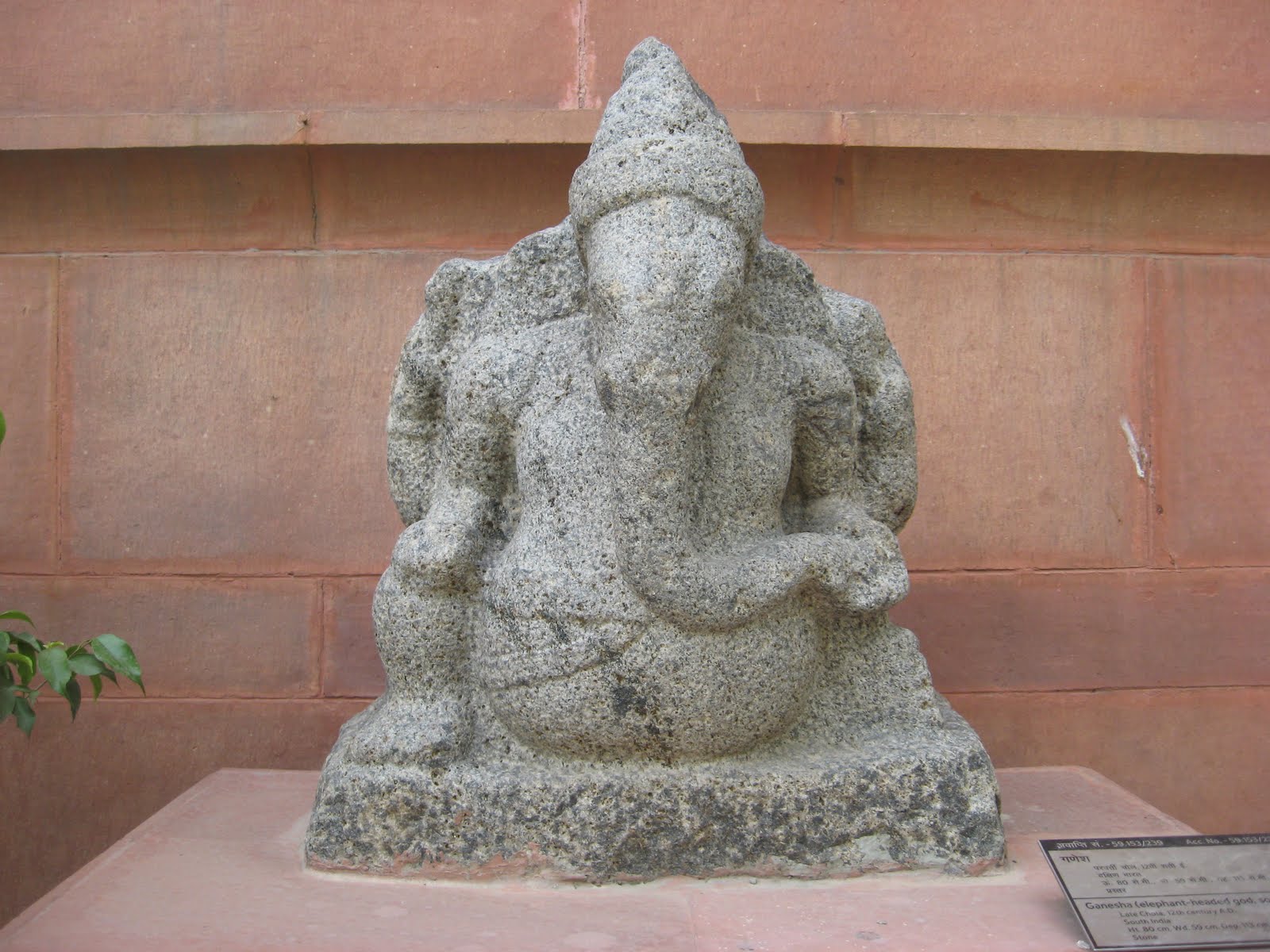
 Ganesha

 Wild boar (?) toy on wheels

 Kingdom from the first millennium B.C.E. in northern Pakistan


Friday, July 1, 2011

First day in New Delhi

India Gate is a memorial for fallen Indian soldiers in World War I. It was not very crowded but there were a few families of Indian tourists taking pictures in front of the monument. It was extremely hot and humid today and we thought it would be cooler to take a tuk-tuk and get there faster.